
The Reality of the Mix
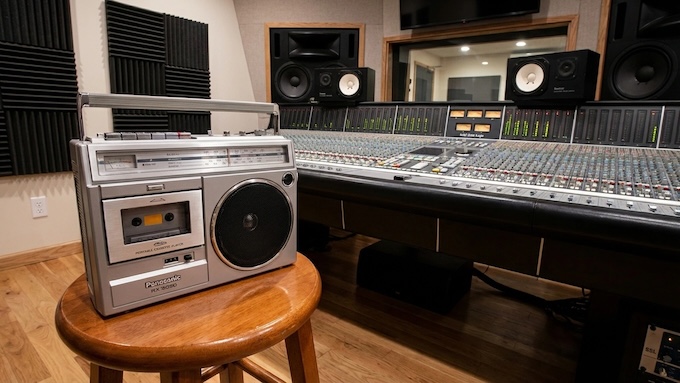
I remember working with Phil Collins years ago. He had a $50 portable Sony cassette player. He’d take a rough mix, go out to his car, or sit in the corner with that cheap little box, and listen.
He wasn't looking for $50,000 monitoring accuracy; he was looking for the emotion. He wanted to know if the song still worked when the "glamour" of the studio was stripped away.
The Lesson: If your mix doesn't move you on a tiny speaker, no amount of high-end gear will save it.
Mixing is the Art of Creating Space
After 30 years at the desk, I’ve realized that mixing is 10% technology and 90% Scrutiny. It is the process of deciding what is important and—more importantly—what is not.
- Frequency vs. Emotion: Don't just EQ to make things "bright." EQ to make them "fit."
- The Volume Trap: If you can't hear the balance at low volume, you’ll never find it at high volume.
- The Scrutiny: I don't just "mix" tracks; I interrogate them until they reveal their best version.
The Evolutionary Mix: When working with George Michael, the desk was in mix mode from day one. We evolved the sound as the song was written. The final mix is simply the natural conclusion of the creative process—not a separate technical task.
The 3-Hour Vocal Ride
Most people think compression handles the volume of a vocal. They’re wrong. Compression is a tone and dynamic tool, but it can’t hear emotion or understand lyrics.
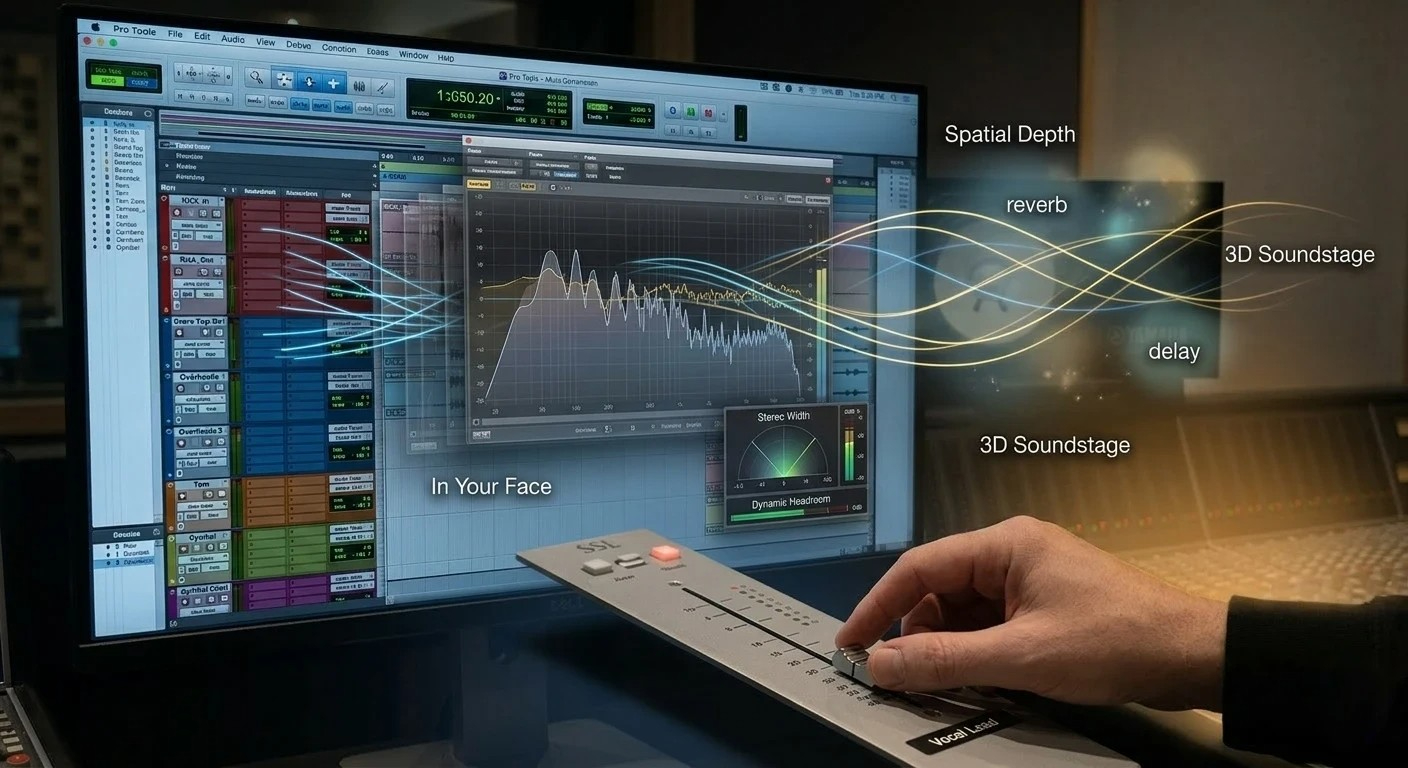
I commonly spend three hours or more manually riding the lead vocal fader. I look at every syllable, every breath, and every consonant.
- Intelligibility: Ensuring the listener never has to strain to hear a word.
- Emotion: Boosting the quiet, vulnerable moments and taming the aggressive ones without "squashing" the life out of them.
- The Result: A vocal that sits "in" the mix but feels like it’s standing in the room with you.


Monitoring: The "Granny" Test
I mix at a level where you can still hold a comfortable conversation in the room. Why? Because if a mix sounds punchy and exciting at 90dB, it will sound massive when it's turned up.
If you mix too loud, your brain’s natural compression kicks in, and you stop making accurate decisions. I also use "real world" speakers. If the vocal doesn't pop on a pair of Auratones or a basic car stereo, it isn't finished. I call it the "Granny Test"—if it sounds balanced to someone who doesn't care about gear, it’s a hit.
EQ & Compression: Stop Tearing Your Song Apart
Many engineers use EQ to "fix" things that shouldn't be there in the first place. My rule: Cut the crap. >
- Subtractive EQ: I spend more time taking frequencies away than adding them. It creates the "Space" we talked about.
- The Compression Trap: Don't compress just because you have the plugin. Every time you compress, you lose a bit of the "life" of the performance. Use it to shape the tone, but use the fader (The Vocal Ride) to shape the volume.
- Phase Accuracy: I scrutinise the relationship between microphones. If your overheads and snare aren't in phase, no amount of EQ will make that drum kit sound "expensive."
The Scrutiny of Space: On the Older sessions, we moved away from traditional plates because they hummed too much. We transitioned to a Lexicon-based palette. I still prefer the Lexicon 224X for its unique warmth—it sits "around" a vocal rather than just "on" it. This isn't just about effects; it’s about choosing the right "air" for the artist.
The Foundation: Forensic Cleaning
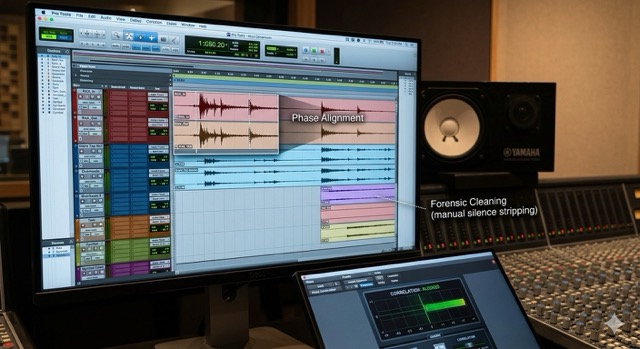
A great mix isn't built on plugins; it's built on a clean session. Before a fader even moves, I perform what I call "Forensic Cleaning."
- Phase Alignment: I scrutinize the relationship between every multi-miked source. If your kick in and kick out aren't perfectly aligned, your bottom end will never have "weight." I spend the time to align every multi-miked source manually before a single plugin is touched.
- The Space Between: I manually strip silence and clean breaths. This lowers the noise floor of the total mix, allowing the reverbs and delays to breathe in a way that "gate" plugins never can.
- Organization as Art: A session must be logical. If I can't find a track in 1 second, I’ve lost the creative flow. I organize for speed so I can mix for emotion.
The Hybrid Edge: Best of Both Worlds
I don't believe in the "Analog vs. Digital" war. I believe in results.
- The Digital Brain: I use the DAW for its surgical precision—automation that would be impossible on a desk and recallability that keeps projects moving.
- The Analog Soul: I still run key elements through my outboard gear. Why? Because high-end transformers and tubes add a "third dimension" and harmonic complexity that digital algorithms are still chasing.
- The Summing Secret: It’s about how the sounds "glue" together. My hybrid workflow ensures your mix sounds like a record, not just a collection of files.
Depth and The Final 5%
Most home mixes are wide but "flat." Professional mixes have Depth—a front-to-back perspective.
- Front-to-Back: I use pre-delay and specific frequency rolling on reverbs to push some instruments back while keeping the vocal "touchable" at the front.
- The Headroom Rule: I never "slam" the master bus. I provide the mastering engineer with plenty of headroom. If you destroy the dynamics in the mix, the mastering stage has nowhere to go.
- Final Scrutiny: The last 5% is where the magic happens. It’s the subtle automation of a guitar swell or the slight widening of a chorus that makes a listener want to hear the song again immediately.